
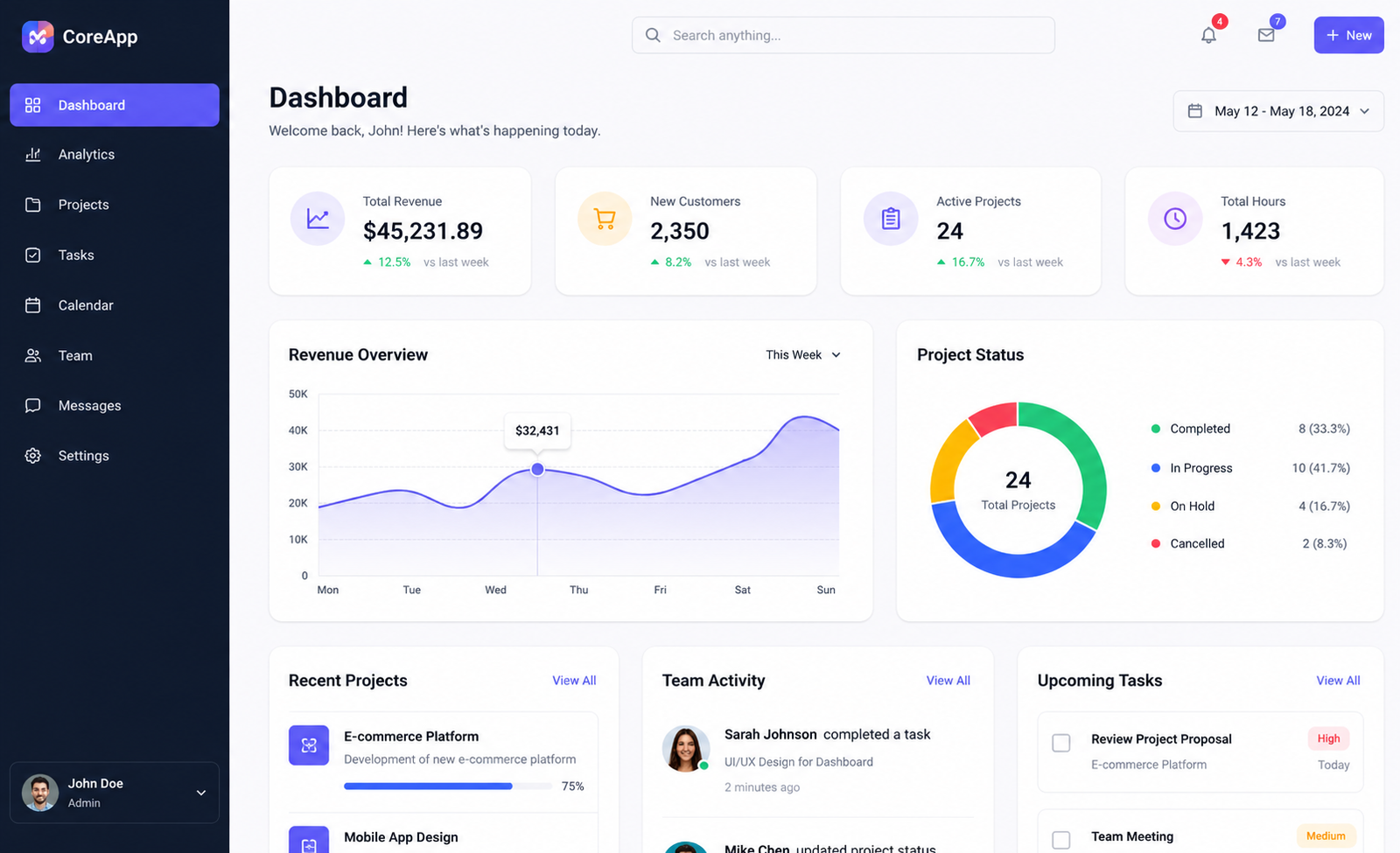
A core app dashboard is the most critical interface in any modern application because it controls how users understand data, take actions, and navigate the entire system. It is not just a visual summary screen but a real-time decision engine that connects backend data with user interaction in a structured and meaningful way.
Top SaaS platforms and UX research sites consistently show that dashboards with clear hierarchy, fast performance, and focused KPIs significantly improve user retention. However, most competitors only explain basic UI components and ignore deeper system-level factors like cognitive load, data density balance, and interaction flow architecture.
In this guide, we go beyond surface-level explanations and include missing industry insights such as attention mapping, dashboard psychology, modular scaling systems, and real SaaS engineering practices. This makes it a complete blueprint for building a high-performing core app dashboard that is both user-friendly and SEO-optimised.
What Top-Ranking Sites Cover and What They Miss
Most top-ranking articles on dashboard design focus on basic UX principles, but they often miss deeper engineering and behavioural layers.
What competitors usually cover:
- Basic dashboard definition
- Simple UI components (charts, tables)
- Generic UX tips
- Mobile responsiveness
What they MISS (Important gaps we are covering):
- Cognitive load distribution in dashboards
- Data prioritisation psychology
- Modular architecture scaling
- Real-time system performance impact
- User role behaviour mapping
- Interaction depth vs surface-level engagement
These missing areas are what make a core app dashboard truly high-performing in real SaaS environments, not just visually good.
What is a Core App Dashboard (Advanced Definition)
A core app dashboard is a dynamic, role-aware interface that translates raw system data into structured decision-making insights in real time. Unlike traditional UI screens, it adapts based on user behaviour, permissions, and data priority layers.
It works on three major layers:
- Data Layer: backend metrics and APIs
- Logic Layer: filtering, aggregation, role rules
- UI Layer: visual representation of insights
This layered structure ensures scalability and prevents performance breakdown in large applications.
Why Core App Dashboards Decide Product Success
Top SaaS research shows that dashboards are not just UI elements — they directly affect product retention and user success metrics.
If users cannot understand a dashboard within seconds, they abandon the system.
Key impact areas:
- User retention rate
- Session duration
- Feature adoption rate
- Task completion speed
A strong dashboard reduces friction between user intent → data → action, which is the core goal of all modern SaaS products.
Core App Dashboard Architecture (Missing from Most Competitors)
Most websites ignore the system design behind dashboards. Here is the real structure used in scalable SaaS systems:
Core architecture layers:
| Layer | Function |
|---|---|
| Data Layer | APIs, databases, streaming data |
| Processing Layer | aggregation, filtering, logic |
| Presentation Layer | UI widgets, charts, cards |
| Interaction Layer | clicks, filters, user actions |
Why this matters:
- Prevents UI lag in large datasets
- Enables real-time analytics
- Supports multi-role systems (admin/user/client)
This architecture is essential for enterprise-level dashboards.
Cognitive Load Theory in Dashboard Design (BIG Missing Topic)
Most competitors completely ignore psychology, but it is one of the most important ranking and UX factors.
Cognitive load means how much mental effort a user needs to understand the interface.
Types of cognitive load:
- Intrinsic load: actual data complexity
- Extraneous load: bad UI design clutter
- Germane load: useful learning effort
Best practices:
- Reduce unnecessary widgets
- Group related KPIs
- Use progressive disclosure (show data step-by-step)
A good core app dashboard always minimises extraneous load.
Core Components of a High-Level Dashboard (Enhanced Version)
Instead of basic lists, here is a real SaaS-level breakdown:
Essential components:
- KPI intelligence cards (not just metrics, but insights)
- Behavioural analytics charts
- Event-driven notification system
- Role-based navigation structure
- Smart filtering engine
Example dashboard structure:
| Section | Purpose |
|---|---|
| Header | alerts, search, quick actions |
| Left panel | navigation + roles |
| Main grid | KPIs + analytics |
| Right panel | insights + recommendations |
This is how modern SaaS dashboards are actually built.
Data Visualisation Strategy (Advanced UX Layer)
Most articles only mention charts, but ignore data storytelling logic.
Advanced visualisation rules:
- Each chart must answer ONE decision question
- Combine related metrics into clusters
- Avoid visual competition between charts
- Use hierarchy: KPI → trend → detail
Example:
- Revenue KPI → monthly trend → product breakdown
This creates a natural decision flow inside the dashboard.
Performance Engineering (Often Ignored but Critical)
A slow dashboard kills user experience instantly.
Advanced optimisation techniques:
- Edge caching for API responses
- Incremental rendering for charts
- Virtualised tables for large datasets
- WebSocket-based live updates
Performance rule:
If dashboard load time exceeds 2.5 seconds, user satisfaction drops significantly.
Personalisation & Adaptive Dashboards
Modern dashboards are no longer static.
Advanced features:
- AI-based widget suggestions
- Behaviour-based layout adaptation
- Role-aware dynamic content rendering
- Smart default dashboards per user type
This creates a self-adjusting UI system.
Security & Compliance Layer (Enterprise Gap)
Most articles skip security depth completely.
Advanced security model:
- Zero-trust architecture
- Token-based session control
- Data-level encryption
- Activity anomaly detection
Dashboards often expose sensitive data, so security is not optional — it is structural.
Real Industry Use Cases (Expanded Version)
SaaS platforms:
- churn prediction dashboards
- subscription analytics
Finance systems:
- fraud detection alerts
- transaction monitoring
E-commerce:
- conversion funnels
- inventory forecasting
Healthcare:
- patient risk scoring dashboards
Each industry requires a different decision logic model, not just UI change.
Core Components of a High-Performance Dashboard
A strong dashboard is built using modular UI components that work together to deliver clarity and control.
Essential components include:
- KPI summary cards (performance indicators)
- Interactive charts and analytics graphs
- Sidebar navigation system
- Notification and alert system
- Search and filtering tools
Each component should have a single purpose and avoid duplication of information.
Example dashboard structure:
| Area | Function |
|---|---|
| Header | Alerts + quick actions |
| Sidebar | Navigation system |
| Main panel | KPIs and charts |
| Footer tools | Settings and logs |
This structure ensures users always know where to look.
Future of Core App Dashboards (AI Era)
Dashboards are evolving into intelligent systems.
Future trends:
- AI-generated insights instead of manual analysis
- Predictive dashboards (before events happen)
- Voice-controlled analytics systems
- Fully automated decision recommendation engines
The future dashboard will act more like an AI assistant than a UI screen.
FAQs
Q1. What makes a core app dashboard successful?
A successful dashboard is fast, simple, role-based, and focuses only on actionable insights instead of raw data.
Q2. Why do most dashboards fail?
Most fail due to cluttered design, poor hierarchy, and lack of user behaviour understanding.
Q3. What is the most important dashboard design principle?
Reducing cognitive load while maintaining clear decision flow is the most important principle.
Q4. How does a dashboard improve business performance?
It improves decision speed, reduces errors, and increases user engagement across the platform.
Conclusion
A core app dashboard is not just a UI screen — it is a full decision-making system that defines how users interact with data and how fast they take action. Most competitors only cover basic design ideas, but real high-ranking dashboards depend on deeper systems like cognitive load management, architecture layers, and behavioural UX design.